
WHAT MOTIVATES DONORS TO GIVE?
BDI 2024 RESCUE MISSIONS STUDY

START HERE

Before you begin your adventure…
This isn’t your typical data study. As you scroll through, you will have several adventures as you seek to understand what motivates Rescue Mission donors to give.
Be careful! There are twists and turns through the data where you’ll be asked to make a choice. Your choice may lead to new donor insights… or result in a dead end. If that happens, have no fear – we’ll help you find your way again!
If you’re ready to begin, keep reading…

CLICK TO EXPLORE
There are many choices a donor makes along their journey to giving a gift. Whether you are new to fundraising or a seasoned nonprofit pro, it’s important to evaluate assumptions against the data to inform your strategy.
Click the location points on the map to explore key insights from the donor motivation study – and come back to them again. Start by exploring the methodology used to gather this study data, which will set the scene for your adventure.

Methodology
This report is based on survey data from 20 Rescue Missions across the US, along with a sample of the general population who fit the donor demographic.
RESPONDENTS
- 2,160 Rescue Mission donors
- 1,004 General population (non-donors)
CRITERIA
- Self-identified Christian
- Gave at least 1 gift in the past 12 months
OBJECTIVE
Understand what motivates Rescue Mission donors to give and what messages they find most compelling.




MEET THE DONORS
Demographic highlights of donors studied
| DONORS | PROSPECTS | |
|---|---|---|
| GENDER | 58% female | 56% female |
| AGE | 50% age 65+ | 47% age 45-64 |
| RACE | 90% white | 81% white |
| EDUCATION | 64% have at least 4-year degree |
50% have at least 4-year degree |
How spiritually engaged are they?
We looked at 5 self-reported spiritual activities to determine a spiritual engagement score for these self-identified Christian respondents:
- How often they read the Bible
- How often they study the Bible
- How often they attend church
- How often they attend small group/Bible study
- How often they pray

The majority of Rescue Mission donors are still Baby Boomers, and are more spiritually engaged as a generation. Among prospects (mostly Gen X), 31% were considered moderate and 36% low on spiritual engagement score. While prospects are less spiritually engaged, many still self-identify as Christian.

HUNT FOR TREASURE

Donor Attitudes Toward Homelessness
How many homeless individuals do donors see?
Just 7% of donors see homeless people where they live or work; 70% of donors see few homeless people or none. Prospects are similar.
In both groups, younger people are far more likely to witness homelessness in their community. Yet, exposure to the needs of unhoused individuals is not essential to motivate giving.

GOOD CHOICE!
You selected “homelessness” – which received the lion’s share of the $1,000.
Top Giving Categories
Average amount given in dollars

*Note: Homelessness may have been top of mind for respondents who received this survey from their local Rescue Mission.
Both prospects and donors view homelessness as a severe issue that must be addressed, even if they aren’t exposed to it in their daily lives. Yet, despite homelessness being a top category for donors to support from the hypothetical $1,000, other causes received 81% of that money on average. Homelessness is not the only cause they feel called to support, but rather one alongside several others.
77% of current donors
do not consider the Rescue Mission they
support to be their top priority in giving.
Takeaway:
One of the most common mistakes organizations make is to think of donors as “our donors” alone. The reality is that the charity a donor gives to may be one of many, so it’s critical that organizations invest in strategies to raise awareness for their brands and tell their unique stories of impact.

EXPLORE DONOR PERCEPTIONS

Take a guided tour of how donors think!
Our survey asked donors what they thought Rescue Missions should do to help people experiencing homelessness. The goal was to determine if donors or prospects were more motivated by providing emergency services (think “meals and shelter”) or long-term care (recovery, job training, long-term housing, etc.).
Services Donors Think Missions Should Prioritize
Donors’ greatest priority is crisis services to address homelessness. Despite their self-identification as Christians, both donors and prospects view spiritual counseling as a lower priority, yet mental health is still important.
Crisis services was also a priority for prospects, alongside long-term housing, jobs and
mental health care.

Services Prospects Think Best Address Homelessness


“Much homelessness stems from mental health issues. Organizations need to address mental health problems and provide services like counseling.”
– Prospect donor
20% of donors and 24% of prospects consider mental health services an extremely high priority.
While measured as a separate priority in this study, addiction recovery is often connected to mental health services at a Rescue Mission. Addiction messaging has a polarizing effect for both donors and prospects – for some it is motivating, for others not.
Takeaway:
Mental health and counseling services are not taboo to donor audiences as they once were in the past. These results demonstrate an opportunity for increased messaging around mental health services to motivate donors to give.
Testing Types of Services in Messaging Focus
Our survey asked donors and prospects to evaluate the impact of 5 different types of messaging on their motivation to give. Male and female images were shown in ads for each type:

Takeaway:
Meal appeals are a proven offer that works for Rescue Missions, yet these results demonstrate more opportunities for offer testing among donors and prospects. Sometimes what people think they prioritize and what they actually prioritize when faced with an appeal can vary.
Mental health and counseling services are not taboo to donor audiences as they once were in the past. These results demonstrate an opportunity for increased messaging around mental health services to motivate donors to give.

LABYRINTH OF
LANGUAGE
What types of messaging motivates donors to give?
We tested four types of spiritual language in fundraising related to homelessness. Respondents were randomly divided into groups, and each group was shown one banner ad.

Which spiritual language do you think these donors were more likely to rate as highly compelling? Choose wisely…




GOOD CHOICE!
You selected “scripture” – which both donors & prospects rated most compelling.
Most Compelling Messaging for Donors
Rated extreme to high

Many Rescue Missions lean into faith-based messaging, assuming that is what their Christian donors and prospects want to hear. Subtle differences within spiritual language may appeal to a wider audience – as “Scripture” did here – so it’s a good idea to test before making changes to your campaigns.
In general, more traditionally Christian language – especially scripture – was rated most compelling for both donors and prospects alike. The ad featured scripture that helped clearly communicate the need for support with the mention of “hunger.”
Takeaway:
Including scripture in messaging can add an extra case for support (i.e., biblical exhortation) that many donors find motivating, more so than generic spiritual language.

SIDE QUEST:
IMAGERY
Do images of men or women motivate donors to give?
Earlier we explored how there was no statistical difference in performance of ads featuring men or women when the focus was on Mission services. However, the performance of images of men and women alongside spiritual messaging revealed some surprising results.
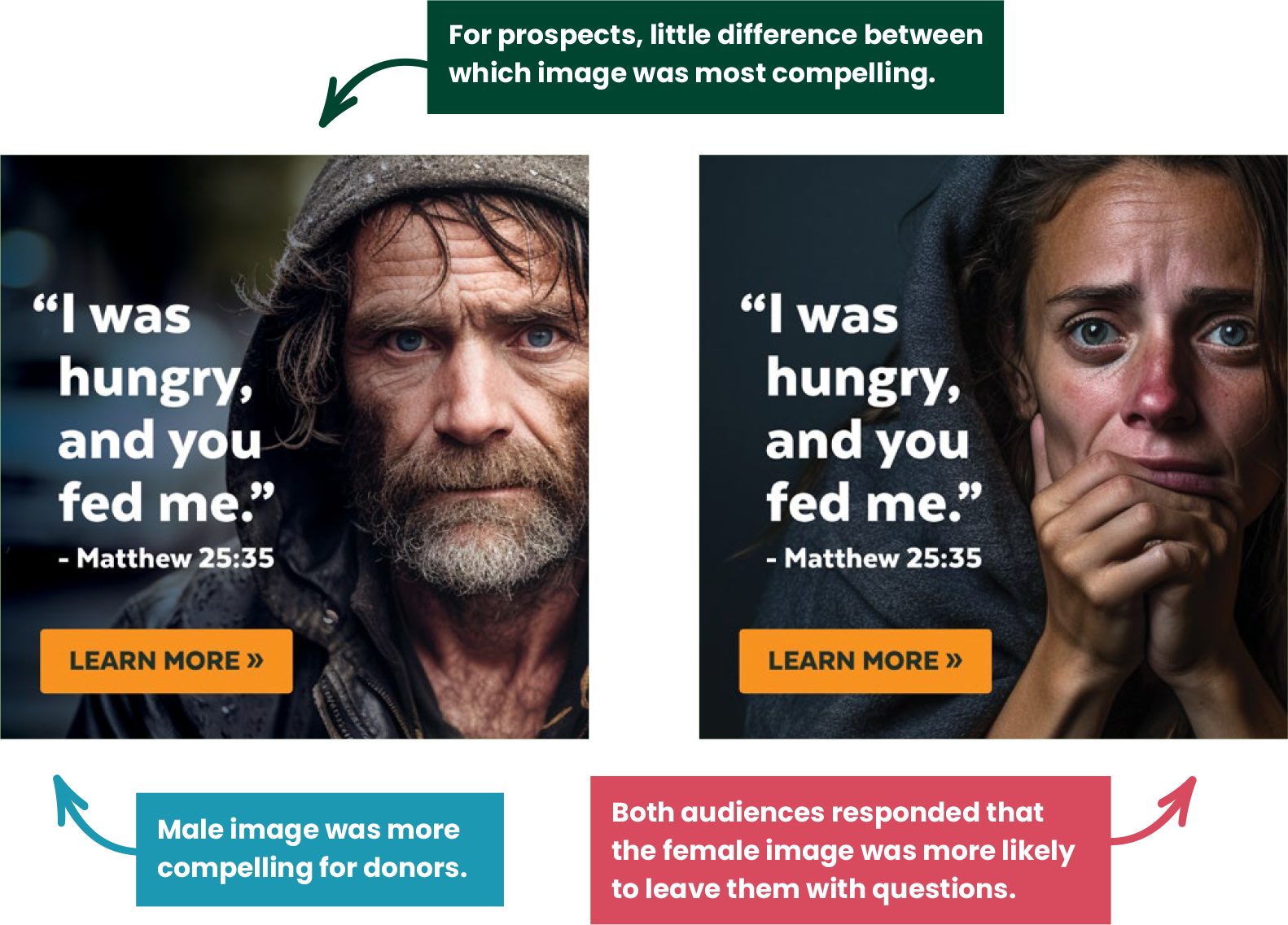
Takeaway:
Both donors and prospects hold an unconscious negative bias toward images of women. Images and stories of women in need should still be shared, but great care should be taken to tell these stories in such a way that inspires empathy in audiences to offset this bias.
YOU’VE REACHED
THE END…
Or is it just the beginning?
Thank you for taking this adventure with us!
You were asked to make several choices along your journey… and each led you to an important discovery in your quest to better understand what makes Rescue Mission donors tick.
As you continue your fundraising adventure, remember the important lesson you learned here: Test always. Avoid making assumptions about your donors and prospects based on their identity or past giving behavior – their giving choices may continue to surprise you!
Do you have questions about this data, or how you can apply these findings to motivate your donors to give?

ABOUT BDI
BDI is an award-winning, omni-channel, full-service fundraising and marketing agency partnering with passionate organizations doing amazing, transformative work at home and around the world.
We come alongside faith-first and cause-driven organizations to help them unlock generosity that transforms lives, delivers dignity and inspires hope. BDI has the tools, the talent and the team to help your organization meet your unique needs and goals.

ABOUT GREY MATTER
Grey Matter Research & Consulting partnered with BDI to bring you the research in this report. Grey Matter is a widely recognized leader in qualitative and quantitative research. Their data has been published by international media including NPR, Christianity Today, Associated Press, Washington Post, and Harvard Business Review, among others.
Keep In Touch